Goldman Sachs and Morgan Stanley turned their Manhattan lobbies into a Starship-and-Mars spectacle this week as SpaceX kicks off a roadshow for what could be a record $75bn listing.
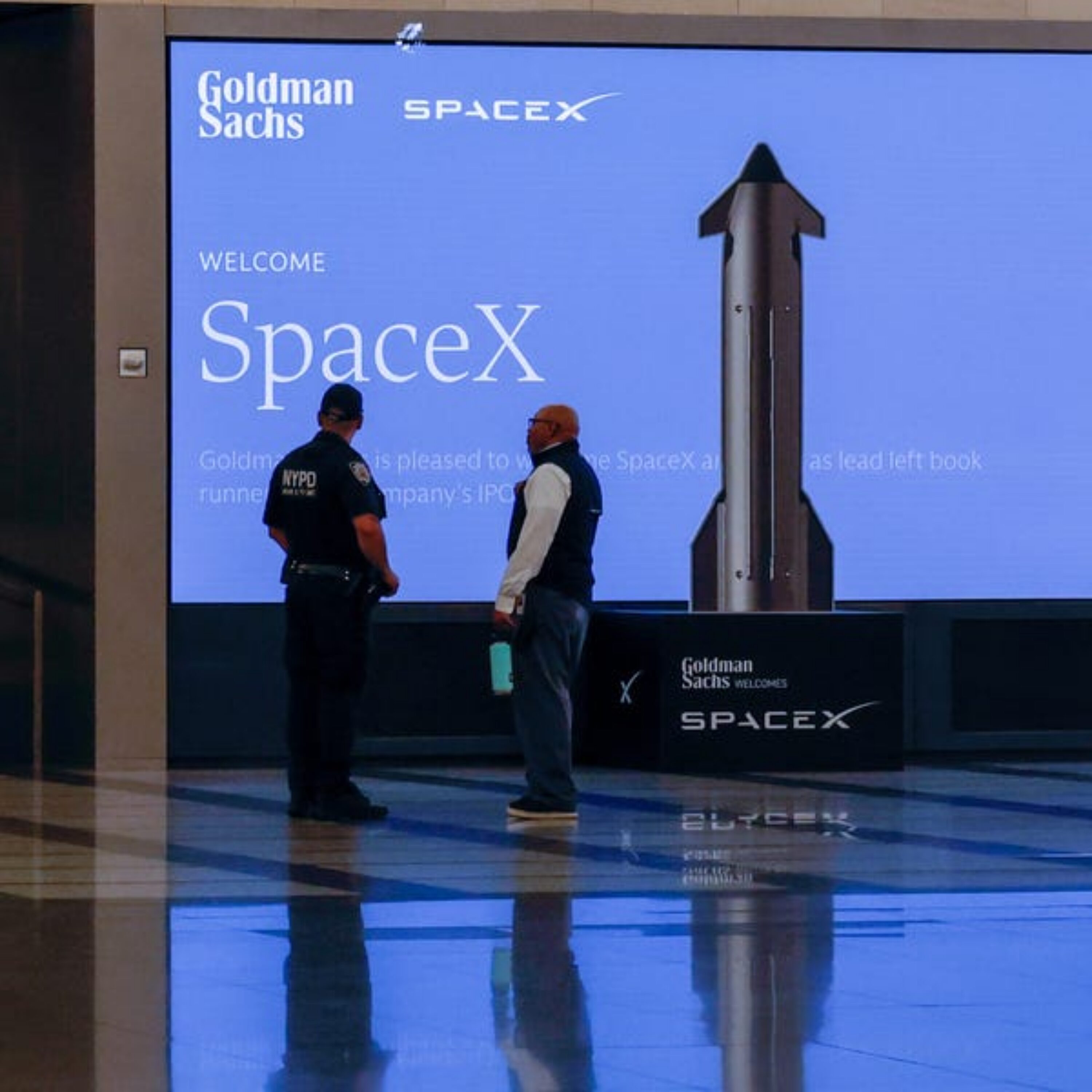
Walk into Goldman Sachs’ downtown Manhattan headquarters this week and the first thing you’ll see isn’t a stock ticker or a logo wall. It’s a rocket.
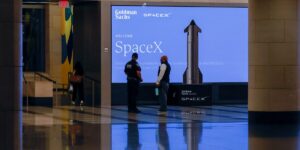
On Wednesday, both Goldman Sachs and Morgan Stanley decked out the lobbies of their headquarters with SpaceX gear, kicking off the roadshow for what is on track to be the largest IPO in history. Goldman plastered its lobby walls with renderings of Starship – SpaceX’s reusable rocket – and touted its role as “lead left” bookrunner. A few blocks away in Times Square, Morgan Stanley draped its entrance gates with SpaceX logos and hung a giant mural of Mars on the lobby wall.
A listing that would dwarf Aramco
According to its SEC filing, SpaceX is seeking to raise $75 billion in the offering, a figure that would more than double Saudi Aramco’s 2019 listing, which has held the record for the largest IPO ever at $29.4 billion. The deal would value Elon Musk’s rocket-and-satellite company at over $1.75 trillion, instantly making it one of the most valuable public companies in the world.
Goldman Sachs and Morgan Stanley are the lead underwriters on the offering, with Goldman scoring the coveted “lead left” spot in the S-1. In banker terms, that’s the name printed top-left on the prospectus cover – and the bank that effectively runs the book.
Hence the rockets in the lobby.
Bloomberg, which first reported the lobby displays, noted Goldman’s signage explicitly described the firm as “lead left bookrunner on the company’s IPO.” Reuters described the broader scene on Wall Street as one in which “investment banking giants are feting investors at splashy investor events.”
What SpaceX actually looks like now
The company going public isn’t the SpaceX of a decade ago. Founded in 2002, SpaceX builds Falcon and Starship launch vehicles, operates the Starlink satellite internet network, and – after merging with xAI in February 2026 at a combined $1.25 trillion valuation – now runs an AI compute business serving customers like Anthropic.
SpaceX reported 2025 revenue of $18.67 billion and a net loss of $4.94 billion, according to the S-1 filed on May 20, 2026. The company is registering up to $80 billion in Class A common stock on Nasdaq and Nasdaq Texas under the ticker SPCX, with pricing expected on June 11 and trading set to begin June 12.
The forecasts the banks are pitching to investors are, by any historical standard, enormous. Goldman projects SpaceX’s AI division alone will generate $322 billion in annual revenue by 2030, with total company revenue topping $470 billion. Morgan Stanley goes further, forecasting SpaceX revenue of $3.4 trillion by 2040 and adjusted EBITDA above $2.7 trillion.
Those are the numbers powering the Mars murals.
The bet behind the branding
The lobby theatrics are also a tell about how the offering will be sold. Morgan Stanley is managing a direct share program that reserves up to 5% of the IPO for SpaceX employees and friends, while Goldman leads a syndicate of 21 underwriting banks. Both firms have spent years competing for SpaceX’s mandate, and the visual one-upmanship – rocket models on one block, a planet on another – is essentially a public scoreboard.
Under SpaceX’s dual-class share structure, Musk retains full voting control as CEO and chairman and is not selling any of his own shares in the IPO. The float will be made up of new Class A stock, leaving the founder’s grip on the company untouched even as it becomes one of the most-traded names on Nasdaq.
For founders watching the roadshow play out, there’s a quieter takeaway buried under the spectacle. The biggest IPO in history is being marketed less like a financial product and more like a mission – Mars on the wall, Starship on the screen, a ticker that reads SPCX. The pitch isn’t a multiple. It’s a destination.
Whether public-market investors buy that pitch at a $1.75 trillion valuation is the question the next week will answer.
Steven Bartlett is an investor in both Founded and SpaceX